
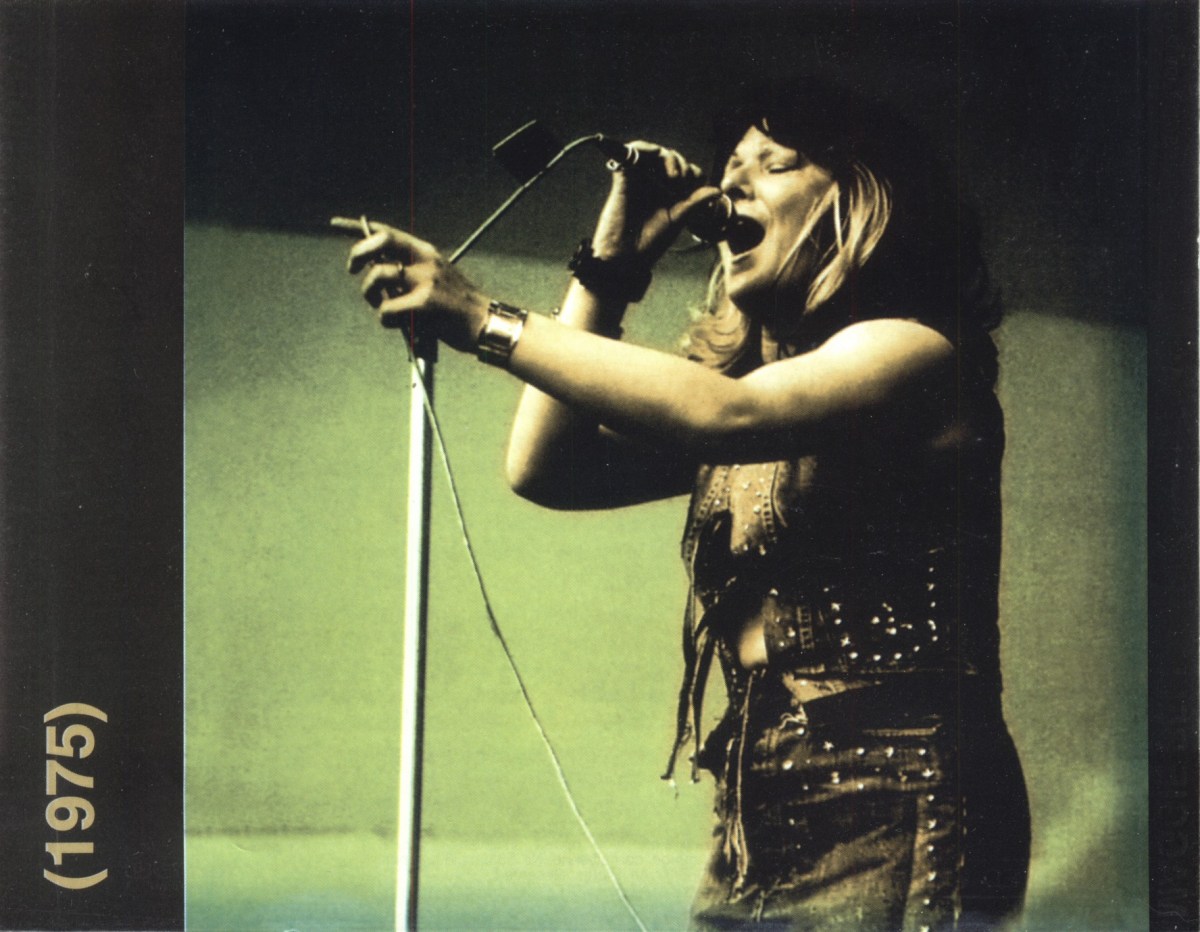
Maggie Bell – Wishing Well

When I heard Maggie Bell a few years ago…the Scottish-born singer blew me away with her voice. A very big Janis vibe to her. I’ve read that she was called the UK’s Janis Joplin but she had her own style.
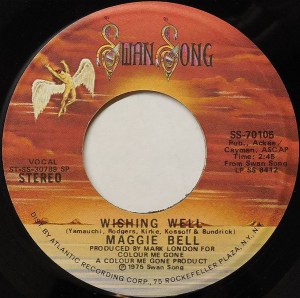
This song was on the album Suicide Sal released in 1975 on Led Zeppelin’s new record label Swan Song. The song was composed by John “Rabbit” Bundrick, Simon Kirke, Paul Kossoff, Paul Rodgers, and Tetsu Yamauchi. Wishing Well was a song by the band Free and it was originally released in 1972. Maggie puts her spin on it and I love it.

Jimmy Page played on this album and I love the funky bass groove that opens the song. The song didn’t chart but she would later have a top 40 song in the UK with the song Hazell.

Maggie Bell was the former lead singer of Stone The Crows. Peter Grant signed the band and had big plans for them. He was the most powerful manager in rock at that time because of Led Zeppelin. The band would come to a tragic end though. Guitarist Leslie Harvey was electrocuted and died on stage at the Top Rank in Swansea on May 3, 1972. He was the only one in position on the stage. Bell has said: “It was a fluke, we were standing at the side of the stage; we hadn’t even started yet. Leslie said to the audience: ‘There’s a technical hitch,’ and he touched the microphone and the guitar. And that was it.”  The road crew overlooked one loose ground wire.

Steve Howe of Yes helped fill in for some shows for the band after that. Jimmy McCulloch then joined them and they released an album with some songs by Harvey and a couple by McCulloch who would later join Paul McCartney and Wings. The band was over in 1973 but Peter Grant continued to manage Maggie til the early eighties.

Bell was in shock for years afterward but she said:  “I thought to myself: ‘Am I going to give all this up and go back up to Scotland and have two kids?’ I mean, this was a dream we’d planned. Peter said there would be no legal problems if I didn’t want to carry on. I said no, there was a plan. I was going to make sure that I finished the journey. I’m seventy-six years old, I’m still doing it. I mean, the body’s falling apart, but the voice is still fabulous!”

Pat Blythe: The Women of Blues Part Four – Maggie Bell | Segarini: Don't  Believe a Word I Say

You can hear Maggie Bell sing on Every Picture Tells Story by Rod Stewart. She was credited as having “vocal abrasives.” I don’t think I ever heard Maggie Bell on American radio which is a shame.

Wishing Well

Take off your hat, kick off your shoes
I know you ain’t goin’ anywhere
Run ’round the town singin’ your blues
I know you ain’t goin’ anywhere.

You’ve always been a good, good friend of mine,
But you’re always sayin’ “Farewell”
And the only time that you’re satisfied
Is when you dream from the wishing well.

Throw down your gun you might shoot yourself.
Or is that what you’re tryin’ to do?
Put up a fight you believe to be right
Someday the sun will shine through.

You’ve always been a good, good friend of mine,
But you’re always sayin’ “Farewell”
And the only time you’re satisfied
Is when you dream, dream from the wishing well.

And I know what you’re wishing for
Love in a peaceful world

You’ve always been a good, good, good friend of mine,
But you’re always sayin’ “Farewell”
And the only time that you’re satisfied
Is with your feet in the wishing well.

Led Zeppelin – Immigrant Song

I’m currently reading a book about John Bonham called Beast: John Bonham and the Rise of Led Zeppelin. So it’s possible you may see another Zeppelin post soon. This song starts like a herd of Vikings coming to pillage your town.

This song was on Led Zeppelin III released in 1970. At the time it was not immediately loved like the first two albums. One reason is that it wasn’t as bombastic as the other two. It mixed in some acoustic numbers along with harder numbers. This album paved the way for their future of mixing light and heavy together that they would master on Led Zeppelin IV and Houses of the Holy.

In the Immigrant song…the band played Iceland and Robert got the idea from there. The line “The hammer of the gods will drive our ships to new lands” would stick with them as The Hammer Of The Gods was a line to describe them as well as a book by Stephan Davis about the band. Plant’s love of history played into the lyric, as he was thinking about explorers like Marco Polo and how they must have felt in their travels.

Led Zeppelin would open their concerts with this song for a couple of years. Zeppelin is hugely popular now with fans and critics alike but it took a while for the critics to be interested. Many didn’t like the fact that they made it so fast and the huge amount of money they were making. Rolling Stone Magazine ran many critical articles about them…accusing the band of hype.

This song was released as a single in some markets. A rare thing in Zeppelin’s world. It peaked at #16 on the Billboard 100, #4 in Canada, and #4 in New Zealand. It was not released as a single in the UK. The band didn’t want any singles released but Atlantic did occasionally much to the band’s frustration.

This song was written by Robert Plant and Jimmy Page. Zeppelin has been singled out for being one of the first bands in “Heavy Metal.” Page does not like that tag. “I’m not really sure where we got that tag, there’s no denying that the elements of what became known as heavy metal is definitely there within Led Zeppelin. But the reality of it is that this is riff music, and riff music goes back to the blues — the electric blues of the ’50s and what was going on down there in Chicago.”

He even refused to be interviewed on “That Metal Show” because…guess why? Because it was called “That Metal Show” so he refused because of the word Metal. The host of the show was Eddie Trunk and he said: “He refuses to do anything with the word ‘metal’ in it. Now, ‘That Metal Show’ was way beyond metal, as anybody who watched it knew. We did all kinds of stuff, but he wouldn’t, he wasn’t having it. It was crazy.”

Robert Plant: “We weren’t being pompous. We did come from the land of the ice and snow. We were guests of the Icelandic Government on a cultural mission. We were invited to play a concert in Reykjavik and the day before we arrived all the civil servants went on strike and the gig was going to be canceled. The university prepared a concert hall for us and it was phenomenal. The response from the kids was remarkable and we had a great time. ‘Immigrant Song’ was about that trip and it was the opening track on the album that was intended to be incredibly different.”

Immigrant Song

Ah-ah, ah
Ah-ah, ah

We come from the land of the ice and snow
From the midnight sun where the hot springs flow

The hammer of the gods
Will drive our ships to new lands
To fight the horde and sing and cry
Valhalla, I am coming

On we sweep with threshing oar
Our only goal will be the western shore

Ah-ah, ah
Ah-ah, ah

We come from the land of the ice and snow
From the midnight sun where the hot springs flow

How soft your fields so green
Can whisper tales of gore
Of how we calmed the tides of war
We are your overlords

On we sweep with threshing oar
Our only goal will be the western shore

So now you’d better stop
And rebuild all your ruins
For peace and trust can win the day
Despite of all your losing

Ooh ooh ooh, ooh ooh ooh
Ahh ah, ooh ooh ooh
Ooh ooh ooh, ooh ooh ooh

Bring It On Home: Peter Grant, Led Zeppelin, and Beyond–The Story of Rock’s Greatest Manager… by Mark Blake

I had a business trip this past week driving a car for at least 10 hours to and from Atlanta and finished up this audiobook about the legendary manager Peter Grant. I have read one book about Grant by Chris Welch but I like this one better. Both of Grant’s kids were interviewed by author Mark Blake and they gave a perspective and info that has never been shared.

Grant had been a van driver, bouncer, stagehand, wrestler, and Don Arden’s assistant. He was 6’3″ and at one time over 300lbs… He road managed the tough and a little crazy Gene Vincent, Little Richard, Bo Diddley, and The Animals before he took over the Yardbirds which then turned into Led Zeppelin.

Grant changed the music business across the board. The promoters would enjoy a 60/40 split and better until Grant. He changed it all to 90/10 split with the artists actually getting the windfall instead of the promoters. His saying was 10 percent of Zeppelin was better than nothing. Now it is an industry-standard. The one other manager that I have read about is Brian Epstein who managed the Beatles. Grant and Epstein were complete opposites except for one thing. There was nothing they would not do for their respective bands. They were both loyal and trustworthy with the band’s finances unlike other band’s managers at the time. That is where the comparison ends.

Grant indeed was loyal to a fault…but he did business by suggestion and intimidation. Pouring water in bootleggers tape recorders, smashing film cameras by fans at concerts, and threating anyone that got in Zeppelin’s way or anyone who might be getting something they shouldn’t. He added to their already dark reputation. He started a Zeppelin label in the mid-seventies called Swan Song and signed Bad Company. He became their co-manager and traveled with them when Zeppelin wasn’t touring. He was even asked by Queen in 1975 if he could manage them…he turned them down because he didn’t have the time.

After Bonham died it became close to impossible to get him on the phone. His drug intake, already heavy, escalated during the early eighties. He did eventually get clean, lose weight, and turn into a living legend and he tried to be an English gentleman.

The book moves at a good pace and it goes over the hype and myths that Grant and Page built for Zeppelin.

If you are a Zeppelin fan or a fan of rock in the seventies it’s a good read. Although Grant could be tough, intimidating, and frankly scary at times…he did have a soft side for his family and of course…Led Zeppelin. I would give it 4.5 stars.

I did learn a new name for a certain drug… “Peruvian Marching Powder”

https://www.youtube.com/watch?v=Kl0CCprghgo