

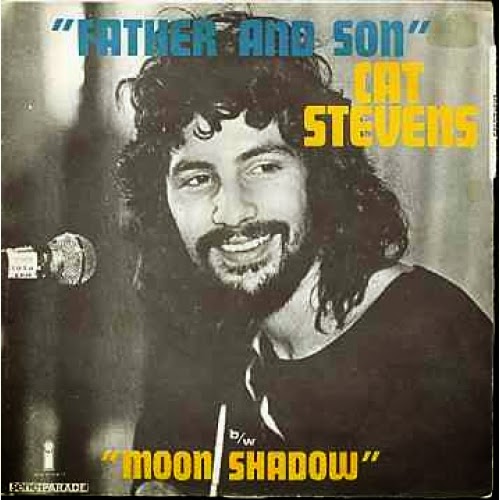
A truly beautiful song by Cat Stevens. It was used as the B-side of Stevens’ hit Moonshadow in some locations.
His dad owned a restaurant in London and Cat (known to his dad as Steve Georgiou) worked there as a waiter right up until he signed a record deal at age 17. Stavros was hoping his son would join the family business.
Steven’s storyline for the song as he was writing it from the perspective of a father and son in a Russian family during the Russian Revolution (1917-1923). The son wants to join the revolution but his father wants him to stay home and work on the farm. Stevens, a huge fan of show tunes, wrote it in 1969 for a musical he was working on called Revolussia, which was set during the Russian Revolution. The song ended up on the Tea For The Tillerman album.
This is the song that got Stevens signed to Island Records. His first two albums were issued on Deram, a division of Decca. Stevens met with Island boss Chris Blackwell to talk about the musical he wrote this song for, but when Blackwell heard the song, he set his sights on getting Stevens on his label as an artist. Stevens’ first Island release was Mona Bone Jakon earlier in 1970; it was not just a new label for Stevens, but a new producer as well, with former Yardbird Paul Samwell-Smith taking the helm from Mike Hurst (ex-Springfields), who helped Stevens get his deal with Decca.
I’m really tired of superhero movies but I’m glad many songs of this era were included in Guardians of the Galaxy Vol. 2…including this one. It exposes a new generation to these songs.
The song peaked at #52 in the UK in 1970.
Cat Stevens on his dad: “He was running a restaurant and I was a pop star, so I wasn’t following the path that he laid out. But we certainly didn’t have any antagonism between us. I loved him and he loved me.”
Cat Stevens: “I was in a Turkish restaurant one day and it came on the radio, one of my children said, ‘Dad, isn’t that your song?’ I said, ‘Why, yes it is!’ It turned out to be Boyzone. It’s a nice version and I’m grateful it was a clean-cut group who did it. I went to meet them at Top Of The Pops and we had a nice time. They’re a good bunch of lads.”
Cat Stevens: “The song is a testament to the differences we represent to each other, especially in age and traditions. Traditions have a big impact on our lives, and sometimes you’ve got to walk away.”
Father and Son
It’s not time to make a change
Just relax, take it easy
You’re still young, that’s your fault
There’s so much you have to know
Find a girl, settle down
If you want you can marry
Look at me, I am old, but I’m happy
I was once like you are now
And I know that it’s not easy
To be calm when you’ve found
Something going on
But take your time, think a lot
Think of everything you’ve got
For you will still be here tomorrow
But your dreams may not
How can I try to explain?
When I do he turns away again
It’s always been the same, same old story
From the moment I could talk
I was ordered to listen
Now there’s a way
And I know that I have to go away
I know I have to go
It’s not time to make a change
Just relax, take it slowly
You’re still young, that’s your fault
There’s so much you have to go through
Find a girl, settle down
If you want you can marry
Look at me, I am old, but I’m happy
All the times that I’ve cried
Keeping all the things I knew inside
It’s hard, but it’s harder to ignore it
If they were right I’d agree
But it’s them they know, not me
Now there’s a way
And I know that I have to go away
I know I have to go

 PowerPop... An Eclectic Collection of Pop Culture