

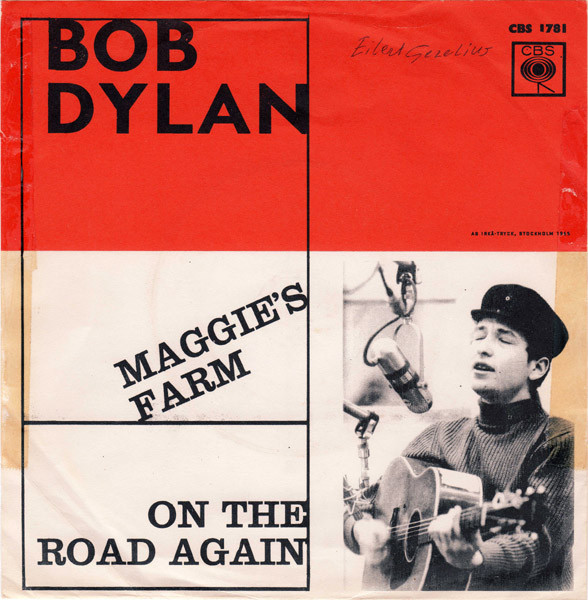
One of the first songs that caught my attention by Bob Dylan. I’ve seen the man live 8 times and this one…he would always play, at least in the first 5 concerts. After that I only heard it once again.
I don’t post many Dylan songs…not because I’m not a huge fan…like I said I’ve seen the man 8 times. If I get a chance, I’ll see him 8 more times. When you post a Dylan song you almost feel the urge to do an interpretation of the song…I have no interest in doing that.
Some think he was inspired by The Bentley Brothers’ “Penny’s Farm,” a 1920s song about a rural landlord. In “Maggie’s Farm,” Dylan included descriptions of Maggie, her brother, her father, and her mother in successive verses.
The song was famous for the reaction it got at the Newport Jazz Festival when Dylan “went electric” to his die-hard folk fans. This appearance by Dylan is portrayed as one of the most important and controversial events in the history of American rock and roll. When the band came out to play his new songs from Bringing It Back Home album…much of the crowd were not amused. They wanted Bob to only play the acoustic and sing protest songs…but Bob had already started opening the folk-rock door earlier with bands such as The Byrds covering his songs.
Some say that most of the booing was not because of the songs but with different things like the short set, the volume level (you couldn’t hear Dylan sing), and other things.
Bob didn’t really care…or he didn’t show it much. He was going to do what he wanted to do. He continued with a different backing band later…and that band heard boo’s around the world…the backing band turned out to be The Band…then known as The Hawks.
Al Kooper organist: The reason they booed is because he only played for 15 minutes and everybody else played for 45 minutes to an hour, and he was the headliner of the festival. […] The fact that he was playing electric…I don’t know. The Paul Butterfield Blues Band (who had played earlier) had played electric and the crowd didn’t seem too incensed.
Maggies Farm peaked at #22 in the UK in 1965.
From Songfacts
Dylan recorded this at one of his first rock sessions on January 15, 1965. He was backed by two electric guitarists, piano, bass, and drums.
Dylan’s famous (some say infamous) set at the Newport Folk Festival on July 25, 1965 marks the split of Bob Dylan with the folk movement when he decided to play a set with a backing band of electric instruments. The set included three songs: “Maggie’s Farm,” “Like A Rolling Stone,” and “Phantom Engineer.”
The audience at the festival was clearly angry with Dylan and they expressed their anger with a growing chorus of boos during the 16-minute set.
The band for this set was hastily thrown together. This would indicate that doing an “electric” set wasn’t necessarily part of Dylan’s plans for this festival.
Several members of this band played with the Paul Butterfiled Blues Band, who played for about 45 minutes just before Dylan took the stage. Guitarist Michael Bloomfield, bassist Jerome Arnold and drummer Sam Lay all played with Dylan that evening. Al Kooper, who didn’t play with the Butterfield band but played the instantly recognizable organ line on “Like A rolling Stone” in the studio recording, rounded out the band. Legend has it that Dylan rehearsed all night with this band the day before the performance, but even with that preparation, the performances were weak. That too could have accounted for the boos.
Al Kooper said later in an interview that he thought the booing was caused by a bad sound system, but recordings don’t bear that out.
But the day before during a blues workshop, Alan Lomax, one of the organizers of the festival, was very condescending in introducing the Butterfield Blues Band. Lomax was a blues purist and felt that white boys had no business playing the blues. That led to a physical fight between Lomax and Albert Grossman who managed both Dylan and the Butterfield Blues Band.
Also, in introducing the evening show, Pete Seeger (another organizer of the festival, and another folk music purist,) played the audience a recording of a newborn baby, and said that the final night’s program was a message from everyone to this baby that the world it was being born into was full of hate, hunger, bombs, and injustice, but that the people – the folk – would overcome, and make it a better world.
Overwrought displays like this also may have set Dylan’s teeth on edge. If he was on the fence about doing an electric set, these two events might have convinced him just to get under the skin of these two pompous organizers.
Or maybe the audience was angry with the short set of only three songs. A rain delay pushed some of the afternoon bands into the evening show. So people had been sitting and waiting for Dylan for a while. Peter Yarrow (of Peter Paul and Mary, and another of the Festival’s organizers) persuaded Dylan to return to the stage to sing a few more songs. Dylan borrowed an acoustic guitar (allegedly from Johnny Cash) and opened with “It’s All Over Now, Baby Blue” while he appeared to be regaining his wits after being blindsided by the boos from the audience.
The acoustic set seemed to placate everyone. Dylan then started to strum the chords to “Tambourine Man” but realized he didn’t have a harmonica. He asked for anyone with an E harmonic to throw it up to him. There followed a barrage of incoming harmonicas hitting the stage. Dylan picked one up, thanked the crowd and played on. (This can be seen on the Songfacts.com video of the song.)
The two recordings of Maggie’s Farm presented here – the acoustic studio version, and the video from the Newport Folk Festival – are good examples of how Dylan’s music changed. In 1963, when Dylan released his first successful recordings, he was hailed as one of the most powerful musical voices in America. By 1965, with the growing influence of the Beatles, and the continued musical conservatism of the folk movement as personified by Pete Seeger, the relationship between the folk movement and Dylan became increasingly strained. The final separation came with “Maggie’s Farm” at the Newport Folk Festival of 1965. (Thanks, David Sherman, who teaches the History of Rock and Roll at Excelsior College.) >>
Making his fifth appearance performing on the Grammys, Dylan played this at the 2011 ceremonies backed by The Avett Brothers and Mumford & Sons.
Festival! was a 1967 documentary film about Dylan’s three mid-’60s appearances at the Newport Folk Festival, including his controversial electric set from 1965. Uncut magazine asked the movie’s director, Murray Lerner, what he could hear on stage, after Dylan came on and played “Maggie’s Farm.”
“I heard a combination of boos and applause,” he replied. “And some catcalls. And then when he came back and did the acoustic songs, they got with it again. He was nervous when he came back, there’s no question about it. That was sweat you can see rolling down his face. And on ‘Mr. Tambourine Man,’ asking for a harmonica from the crowd – the fact that he forgot his harmonica.”
Maggie’s Farm
I ain’t gonna work on Maggie’s farm no more
No, I ain’t gonna work on Maggie’s farm no more
Well, I wake in the morning
Fold my hands and pray for rain
I got a head full of ideas
That are drivin’ me insane
It’s a shame the way she makes me scrub the floor
I ain’t gonna work on Maggie’s farm no more
I ain’t gonna work for Maggie’s brother no more
No, I ain’t gonna work for Maggie’s brother no more
Well, he hands you a nickel
He hands you a dime
He asks you with a grin
If you’re havin’ a good time
Then he fines you every time you slam the door
I ain’t gonna work for Maggie’s brother no more
I ain’t gonna work for Maggie’s pa no more
No, I ain’t gonna work for Maggie’s pa no more
Well, he puts his cigar
Out in your face just for kicks
His bedroom window
It is made out of bricks
The National Guard stands around his door
Ah, I ain’t gonna work for Maggie’s pa no more
I ain’t gonna work for Maggie’s ma no more
No, I ain’t gonna work for Maggie’s ma no more
Well, she talks to all the servants
About man and God and law
Everybody says
She’s the brains behind Pa
She’s sixty eight, but she says she’s fifty four
I ain’t gonna work for Maggie’s ma no more
I ain’t gonna work on Maggie’s farm no more
No, I ain’t gonna work on Maggie’s farm no more
Well, I try my best
To be just like I am
But everybody wants you
To be just like them
They sing while you slave and I just get bored
I ain’t gonna work on Maggie’s farm no more
 PowerPop... An Eclectic Collection of Pop Culture