This will wrap up the visit to the 60s and ’70s San Francisco sound. Sorry for not covering The Grateful Dead and Joplin…but I post those two regularly. My whole reason for blogging is to learn new artists and the stories behind those artists and songs. This week I posted 4 artists I never posted about before. I also picked up a few good songs. I was impressed by these artists. Also thank you to the ones who told me their stories of that time… Phil, Jim, and halffastcyclingclub…those are the stories I love hearing.
***Also, I want to ask my readers something…were you at the famous Watkins Glen concert held in New York in 1973 that drew 600,000 people? If you were there I would love to hear your story. Jim has given me his story so I can repost my post about that concert on the anniversary. Thank you so much.
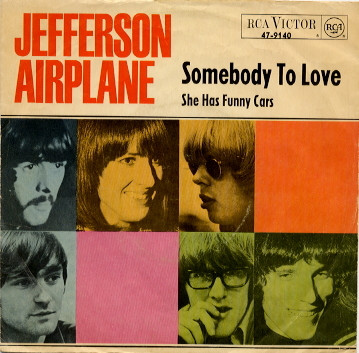
I’ve only posted one song by this band version, so I’m happy to do another. I always favored the Airplane over Jefferson Starship a little and REALLY favored either one over just the 1980s Starship. I first learned about them in Gimme Shelter…the Stones film about Altamont and the destruction there. Marty Balin was knocked out cold there by the Hell’s Angels.
And here it is…”You gotta keep your bodies off of each other unless you intend love…” Grace Slick.
This is one of those songs played in most movies about the 1960s. It’s one of those songs that transport you there even if you weren’t…at least you think you are.
Grace Slick was in a band named The Great Society that featured her brother-in-law who wrote this song, Darby Slick. She was married to Jerry Slick, the drummer of the band. It was released as a single from that band but did nothing. The Great Society also did another song that Slick wrote…White Rabbit.
Darby Slick started to see the downside to free love that was taking over. He saw jealousy and disconnect with some. This song is about loyalty to one person and finding one person to be with.
The Great Society opened for the Jefferson Airplane at some shows. Grace Slick said she always looked at them with awe. When she was approached to join, she jumped at the chance. That essentially ended The Great Society. She brought both songs over with her to Jefferson Airplane. They play it faster, harder, and cleaner. They set up the pause before the chorus that kicks the whole song forward using dynamics. And their arrangement suits Grace Slick’s voice much better than the original.
The song was on the Surrealistic Pillow album released in 1967. The album peaked at #3 on the Billboard Album Charts and #5 in Canada.
Somebody To Love peaked at #1 in Canada and #5 on the Billboard 100.
Somebody To Love
When the truth is found to be lies And all the joy within you dies Don’t you want somebody to love Don’t you need somebody to love Wouldn’t you love somebody to love You better find somebody to love Love, love
When the garden flowers, baby are dead, yes and Your mind, your mind is so full of red Don’t you want somebody to love Don’t you need somebody to love Wouldn’t you love somebody to love You better find somebody to love
Your eyes, I say your eyes may look like his Yeah, but in your head, baby I’m afraid you don’t know where it is Don’t you want somebody to love Don’t you need somebody to love Wouldn’t you love somebody to love You better find somebody to love
Tears are running down They’re all running down your breast And your friends, baby They treat you like a guest Don’t you want somebody to love Don’t you need somebody to love Wouldn’t you love somebody to love You better find somebody to love
One pill makes you larger, and one pill makes you small And the ones that mother gives you, don’t do anything at all
I want to thank everyone for reading and commenting this week. I’m going to continue this for one more day and we will wrap it up tomorrow. Thanks Again!
This song was on the great album Surrealistic Pillow released in 1967. The intro is around 28 seconds before Slick starts singing. It’s well worth the wait…this song IS the sixties encapsulated in two minutes and thirty-two seconds.
Grace Slick got the idea for this song after taking LSD and listening to the Miles Davis album Sketches Of Spain, especially the opening track, “Concierto de Aranjuez.” The Spanish beat she came up with was also influenced by Ravel’s “Bolero.”
She based the lyrics on Lewis Carroll’s 1865 children’s book Alice In Wonderland (officially Alice’s Adventures in Wonderland).
Slick wrote this song and performed it when she was in a band called The Great Society with her first husband, Jerry Slick. The Great Society made inroads in the San Francisco music scene, but released just one single, “Somebody To Love”, before calling it quits in 1966.
The Great Society version of “White Rabbit” was released in 1968 on an album called Conspicuous Only In Its Absence (credited to “The Great Society With Grace Slick”).
Grace Slick moved on to Jefferson Airplane, and the group recorded both “White Rabbit” and “Somebody To Love.” The songs were the breakout hits for the band, with “Somebody To Love” reaching #5 US and “White Rabbit” peaked at #8 in the Billboard 100 and #1 in Canada in 1967.
Grace Slick: “I always felt like a good-looking schoolteacher singing ‘White Rabbit.’ I’d sing the words slowly and precisely, so the people who needed to hear them wouldn’t miss the point. But they did. To this day, I don’t think most people realize the song was aimed at parents who drank and told their kids not to do drugs. I felt they were full of s–t, but to write a good song, you need a few more words than that.”
From Songfacts
Grace Slick was raised in a tony suburban household in Palo Alto, California, about 30 miles south of San Francisco. This being the 1950s, women were expected to conform to the norms and aspire to be housewives. Slick identified with Alice; moving to San Francisco and forming a rock band was her “rabbit hole” moment. When she joined Jefferson Airplane, that was another journey down the rabbit hole.
Slick claimed to Q that the song was aimed not at the young but their parents. She said: “They’d read us all these stories where you’d take some kind of chemical and have a great adventure. Alice in Wonderland is blatant; she gets literally high, too big for the room, while the caterpillar sits on a psychedelic mushroom smoking opium. In the Wizard of Oz, they land in a field of opium poppies, wake up and see this Emerald City. Peter Pan? Sprinkle some white dust-cocaine-on your head and you can fly.”
This was one of the defining songs of the 1967 “Summer Of Love.” As young Americans protested the Vietnam War and experimented with drugs, “White Rabbit” often played in the background.
The song begins in F-sharp minor, which Slick chose to suit her voice. The minor chords evoke a darkness and uncertainty as Alice finds herself in a strange world. In the “go ask Alice” part, it shifts to major chords to celebrate her courage and resourcefulness as she finds her way.
The Alice character appealed to Slick because she wasn’t the stereotypical damsel in distress. Alice follows her own path to satisfy her curiosity – even when things get sticky.
Did the band ever get sick of this song? Grace Slick answered this question in a 1976 interview with Melody Maker when she replied: “I can play around with a song on stage without ruining it. We stopped doing ‘White Rabbit’ for a couple of years because we were getting bored with it. I like it again and we included it last year ’cause it was the year of the rabbit.”
The words “white rabbit” never show up in the lyric, but are alluded to in the lines:
And if you go chasing rabbits
And you know you’re going to fall
In Alice In Wonderland, the first chapter is “Down the Rabbit-Hole.” On the first page, the White Rabbit appears, leading Alice on her adventure. In 1971, Led Zeppelin released “Black Dog,” another song with a color-animal title that doesn’t appear in the lyric.
The Airplane were frequently found giving free concerts around the Haight-Ashbury area of San Francisco. They shared a large house with several musicians during the psychedelic ’60s, often applying for and receiving parade permits to walk the streets. Grace Slick was always a radical thinker, rejecting “daddy’s money.” She once appeared on The Smothers Brothers Comedy Hour made up in blackface, causing a big controversy.
The line in this song, “go ask Alice,” provided the title of a 1971 book published by an anonymous author. The book was a “diary” of a young girl in the 1960s who had a drug addiction and died. Her name is never given, and the diary is suspected to be fictional despite being promoted as true. The anonymous author is likely Beatrice Sparks, the book’s editor.
This capped off Jefferson Airplane’s set at Woodstock in 1969. They took the stage at 8 a.m. on the second day (or, depending how you look at it, third morning), following a performance by The Who that started at 5 a.m.
According to Grace Slick’s autobiography, the album name came when bandmate Marty Balin played the finished studio tapes to Jerry Garcia of The Grateful Dead, whose first reaction was, “Sounds like a surrealistic pillow.” Slick says that she loves the fact that the phrase Surrealistic Pillow “leaves the interpretation up to the beholder. Asleep or awake on the pillow? Dreaming? Making love? The adjective ‘Surrealistic’ leaves the picture wide open.”
This is used in the stage production The Blue Man Group, and appears on their 2003 album The Complex. Music is a big part of the show, which features three blue guys engaging the audience with a combination of comedy, percussion, and sloppy stunts. They got a lot of attention when they were used in ads for Intel.
Grace Slick wrote this song on an old upright piano she bought for $80. Some of the keys in the upper register were missing, but she didn’t use those anyway.
This song is heard multiple times in the movie The Game with Michael Douglas. It demonstrates the madness Douglas feels as he is being manipulated by forces he can’t control. >>
In the film Fear and Loathing in Las Vegas, there is a scene where Dr. Gonzo is in a bathtub and this song is playing on a tape player. In an effort to end his life, Gonzo implores Raoul Duke to put the tape player in the tub “When White Rabbit peaks.” Instead of doing as instructed, Duke throws a grapefruit at Gonzo and unplugs the tape player. >>
This was used as the theme song for a 1973 movie called Go Ask Alice.
On November 7, 1967, the St. Louis radio station made a bold move, switching from an easy listening format to “real rock radio.” The first song they played after the switch was “White Rabbit,” a clear signal that they were aligning themselves with the counterculture. The song was apropos, as they abandoned their reliable conservative audience to go down the rabbit hole, bringing the movement to the midwest.
The format stuck. KSHE became a vital and transgressive voice, breaking new bands, sometimes letting music play for hours on end without interruption, and doing segments devoted entirely to women in rock (their “American Woman” series).
Recalling the song in a 2016 Wall Street Journal interview, Slick said: “Looking back, I think ‘White Rabbit’ is a very good song… My only complaint is that the lyrics could have been stronger. If I had done it right, more people would have been annoyed.”
The UK version of the album didn’t include this track.
This was used in the first episode of Stranger Things, “The Vanishing Of Will Byers.” It plays as Eleven flees Benny’s diner.
White Rabbit
One pill makes you larger, and one pill makes you small And the ones that mother gives you, don’t do anything at all
Go ask Alice, when she’s ten feet tall
And if you go chasing rabbits, and you know you’re going to fall Tell ’em a hookah-smoking caterpillar has given you the call
And call Alice, when she was just small
When the men on the chessboard get up and tell you where to go And you’ve just had some kind of mushroom, and your mind is moving low
Go ask Alice, I think she’ll know
When logic and proportion have fallen sloppy dead And the white knight is talking backwards And the red queen’s off with her head Remember what the dormouse said Feed your head, feed your head



 PowerPop... An Eclectic Collection of Pop Culture