

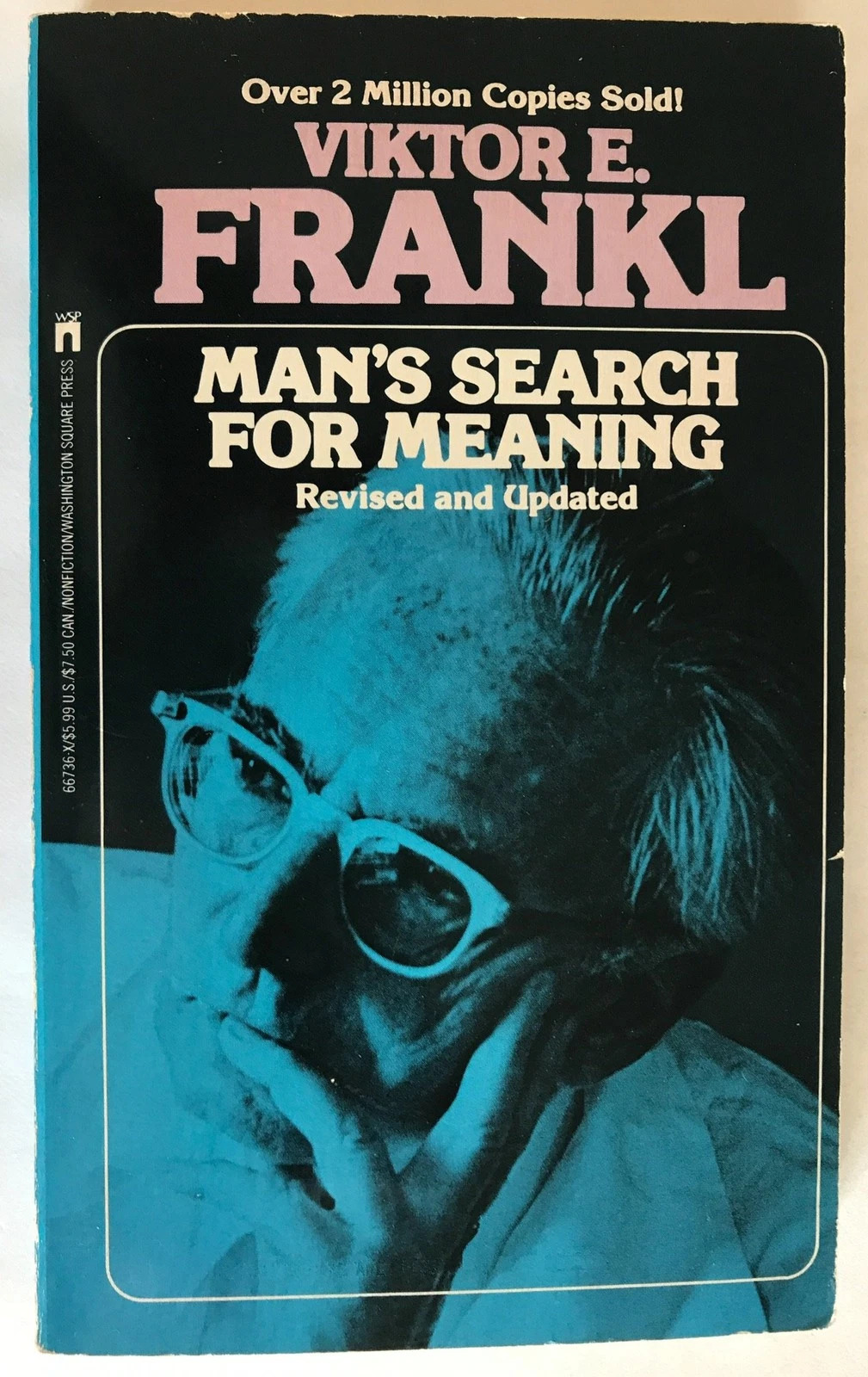
Viktor E. Frankl: Everything can be taken from a man but one thing: the last of the human freedoms—to choose one’s attitude in any given set of circumstances, to choose one’s own way
A friend recommended this for me, and I didn’t know what to expect. It’s a true story about a Jewish doctor who was in concentration camps during WW2. This guy was something special. He flat-out refused to be labeled as a victim after it was over and up to his death. His Jewish peers didn’t always like this, but Frankl moved on with his life and used his experience in the concentration camps to help people and to write this book.
He purposely left out the more gruesome details of his experience. He said in the book that you can easily look that up if you want to hear those details. Don’t get me wrong, it was still some of the worst experiences that you can imagine. The book has me thinking about how to handle situations better. You can really learn a lot from this.
Frankl was a psychiatrist in Vienna before World War II, already developing ideas about meaning and purpose as central to human psychology. That work was interrupted when he and his family were deported to Nazi concentration camps, including the Auschwitz concentration camp and later the Dachau concentration camp. His parents, brother, and pregnant wife did not survive. Frankl spent years moving through camps, observing not just suffering, but how different people responded to it.
While imprisoned, Frankl began shaping what would later become his theory of logotherapy (a meaning-centered psychotherapy focused on helping individuals overcome distress by finding purpose in life, even amidst suffering), the idea that the primary human drive is not pleasure or power, but the search for meaning. He paid close attention to prisoners who maintained a sense of purpose, even in small ways, and noted how that often affected their ability to endure.
After being freed in 1945, Frankl returned to Vienna. Within about nine days, he dictated the manuscript that would become Man’s Search for Meaning. The original German title was …trotzdem Ja zum Leben sagen (“…Nevertheless Say Yes to Life”). It was first published in 1946, initially with modest expectations, as one of many postwar accounts of camp life.

 PowerPop... An Eclectic Collection of Pop Culture
Awesome! 😎
LikeLiked by 1 person
It sounds like it would put most things in a better perspective indeed. I’ll give it a go soon
LikeLiked by 1 person
I think you might like it Dave. You said it perfectly…it does put things in perspective. He had training to somewhat deal with what he went through…although no amount of training would get anyone ready for that.
LikeLike
Know of Vicktor but havent read this. Again Max on similar wavelength. Im reading the ‘Life and Death of Adolf Hitler’ right now. I revisit this part of history often. Reading, watching, listening. It just has my interest. Surviving an experience like Frankl’s I can only imagine. I would recommend the doc ‘Shoah’ Max. It is a big chunk but well done. I will definitely pick up this book in my travels. Your 5th paragraph is something that always fascinates me. How different people get through traumatic, horrifying situations. Doesnt get ant worse than this.
LikeLiked by 1 person
Thanks CB…I will check it out. I would rather see a well made documentary or book than a movie about something anyday.
I’m trying to expand my reading on subjects I normally wouldn’t read…and this book…really blew me away. What really hit me was his demand that he was not to be painted as a victim.
I just looked up Shoah…thanks man as always. He had training but like I told Dave…no amount of training can get you through this. The book has really made me think about how to handle situations.
LikeLiked by 1 person
Love his words
LikeLiked by 1 person
Yes…I do as well Beth…an inspiration.
LikeLiked by 1 person
This is apropos to what I am dealing with.
LikeLiked by 1 person
It’s very powerful…made me look at things differently
LikeLiked by 1 person
Thanks for sharing.
LikeLiked by 1 person
Thanks for reading Vic. It’s worth checking out. It’s a quick read
LikeLiked by 1 person
Very interesting, Max.
LikeLiked by 1 person
It’s really helped me… I never read a book about this.
LikeLiked by 1 person
After just reading your post on The Prisoner and then this, I wonder how Frankl’s theory would apply to #6? In this case, #6 would accept he’s a prisoner and be one of the others instead of refusing to accept it and trying to get away. Or… #6’s purpose is getting away and that keeps him going.
A sense of purpose or meaning is key to going on, I totally agree. Thanks for the freebie and the videos. Cannot even begin to imagine having been someone in one of those death camps. I think of all of the prisoners currently detained in fema camps.
LikeLiked by 1 person
It’s so interesting to apply his philosphy to everyday life. He knew how to bridge his experience to it. This is new to me…I never got into self help books…this one isn’t exactly that…but it works out that way.
LikeLiked by 1 person
Max, I know I’ve read wise quotes from it before but never the whole book. I also didn’t know Frankl had survived death camp and the rest of his family killed (hopefully quickly and painlessly) I started to watch the video where he talks about seeing Mengele and I knew it would trigger me so I stopped.
LikeLiked by 1 person
Sometimes you wonder how people can survive the horrors that life can force us through. I guess he found a way that he could work with. But, my God, how bleak must be the dark hours when you are lying in bed, thinking back. All his family, taken. Putting his thoughts and observations into a book must be some kind of help.
LikeLiked by 1 person
Yea…and the fact that he turned around and helped people with the awful knowledge that he had. Everyday you never knew if they were going to pick you are not to die. He did say when it was over and the Red Cross came in…the soldiers suddenly got all nice….they were afraid that the roles would be reversed.
LikeLiked by 1 person
It was a terrible and traumatic time. My parents rarely talked about their war experiences. Most of Europe was left a smoking broken war zone.
LikeLike
Max, you are fascinating. Nowhere in this blurb do you offer a review of the book. A description? Yes, and the description is intriguing. An excellent discussion of where the book comes from.
You tell us “A friend recommended this for me”. You don’t tell us why. Maybe it is just me, but I think it is clear that the reason is neither relevant nor any of our concern. You don’t say that, but I think it is clear.
(No, I’m not prying. I’m not asking. I am gobsmacked by what you have done in this entry. I mean, jaw on the floor amazed. This is incredible.)
You tell us the circumstances of the book. You make me want to read it, and that is a high compliment. You give us the theory without many details. I am gobsmacked by what you have shared with us.
Frankl is, of course, correct in what you have quoted. It is all about attitude. That is a truth I was raised with, a truth that was always presented both as a truth of life and a compass for how to live. I’ve not heard of Frankl before, but his ideas have been a big part of the environment I grew up in.
The smart alek side of me points to the end of the first paragraph as a Fleetwood Mac reference. Or is that a Bill Clinton quoting Fleetwood Mac reference?
But somehow, Max gets to the heart of what I got out of scanning the book. Max says, “the book has me thinking about how to handle situations better.”
The smart alek side of me points to the quote Max takes from Frankl. Is it a Fleetwood Mac reference? Or should I say a Bill Clinton quoting Fleetwood Mac reference?
Like I said, fascinating. Not the book so much as how Max handles it.
LikeLiked by 1 person
LOL… well the friend that did reccomend it just did it in passing. Now that you said that…this is not the kind of book you just reccomend lol…but I’m grateful he did. I’ll ask him.
Well…when I tried to properly “review” a book…I gave too much away….so it’s more about how I feel about the book and the story of the book. I don’t like giving too much away…
Also…we all take some things differently out of a book. I don’t try to influence that. Just give people an understanding of what it’s about…and they can judge on that if they want to read it.
Arthur….in other words…it’s just me talking to people like I would face to face. That is why I’m not a real “writer”… I just communicate with people like they are in front of me.
It is a great book though! If it was bad….I would either not have wrote it up or I would have said…avoid this book.
LikeLiked by 1 person
Max, the idea that you are not a writer just doesn’t hold up. You are an excellent writer. It may not be how you view yourself, but the fact is there is a clarity and intelligence in your posts that would be hard to find elsewhere. Look at the collection of participants who hang out here. All intelligent, insightful people. But in my opinion, none of their blogs, as excellent as they are, come close to you and PowerPop.
Look at the entry we are on. You take a book that is dated, horrific and get people, intelligent people interested in reviewing it. It makes no difference that what is said has been a part of the general theoretical environment that most of us already embrace. What Frankl says is still relevant, still valid. And instead of presenting Frankl’s concepts, you give us the book and enough ticklers to get a whole lot of intelligent people already familiar with the point of the book, even if we never heard of Logo…whatever he calls it. We want to read it.
That’s you, Max. And I’m a fan. A big fan.
I
LikeLiked by 1 person
I appreciate it…I guess what I mean by that is the way journalists write. They are more neutral than I am and don’t express their feelings…but I can’t do that. If I post it, I’m emotionally tied to it.
LikeLiked by 1 person
No, you are not a “journalist.” And that’s a good thing.
Have you read the quality of writing of the people who hang out here? You got an impressive list of folks here. But it doesn’t surprise me that despite these folks having their own blogs, the community seems (at least to me) centered here at PowerPop. It all comes together here.
One of the reasons for that is because you handle your subjects differently enough to be interesting. The fact that you think highly of this book is more of a selling point than what the book itself says. I’m not putting down the book in any way. What I am saying is that the point of view you take is repeatedly top notch and fascinating.
LikeLiked by 1 person
Well I appreciate that…like I said…I do this as if I’m talking to everyone in the same room…
I guess enthusiasm sells things sometimes. I don’t lack that…
Beware Arthur, now I’m reading another book…so get your life preserver on…it’s called On a Sea of Glass: The Life & Loss of the RMS Titanic.
LikeLike
Sounds like it is wet all over.
LikeLiked by 1 person
Sounds like a very important book and subject. I’m not much of an audio book listener, but I will definitely try to listen to this. Thanks for bringing it to my attention.
LikeLiked by 1 person
No problem…I never read books like this but Im trying to expand a little…and I never read a “self-help book” but I guess this could be considered one….but one written in the extreme. You have to admire the guy for refusing to be labeled a victim.
LikeLike
It is amazing how resilient humans can be. Thank you for sharing this, Max.
LikeLike
This book sounds very intriguing. I’ve visited various Holocaust-related sites over the past four decades (most recently the impressive Anne Frank House and Museum in Amsterdam, The Netherlands). It still blows my mind each and every time how such evil could have been possible. Since history does have the tendency to repeat itself, it’s very important to keep the memory of the Holocaust alive. While I imagine logotherapy has had its critics, I can generally see that aiming to find purpose in life, even in life-threatening conditions, could be a powerful concept to endure or address adversity.
LikeLiked by 1 person
The book has helped me in everyday life. It really has…and I’m glad he didn’t sensationalize the experience…he kept it low key but…it was amazing that you could come out of that with a positive experience.
LikeLiked by 1 person
I guess it takes a strong will, especially if you live in very dire conditions, but conceptually, it sounds like a powerful approach to me!
LikeLiked by 1 person
I will be picking this one up
LikeLiked by 1 person
I think you will like it Keith!
LikeLiked by 1 person
You may have just convinced me to re-read it. I read the book in the early 70s and how I think of meaning is very different than how I thought then (or at least I think that’s the case). I’m curious as to how I’ll view it now.
LikeLiked by 1 person
I’m new to these kinds of books…but what I said is what I felt or got from it. Now I’m reading about The Titanic…one disaster after another. Please let me know though what you think.
LikeLiked by 1 person