

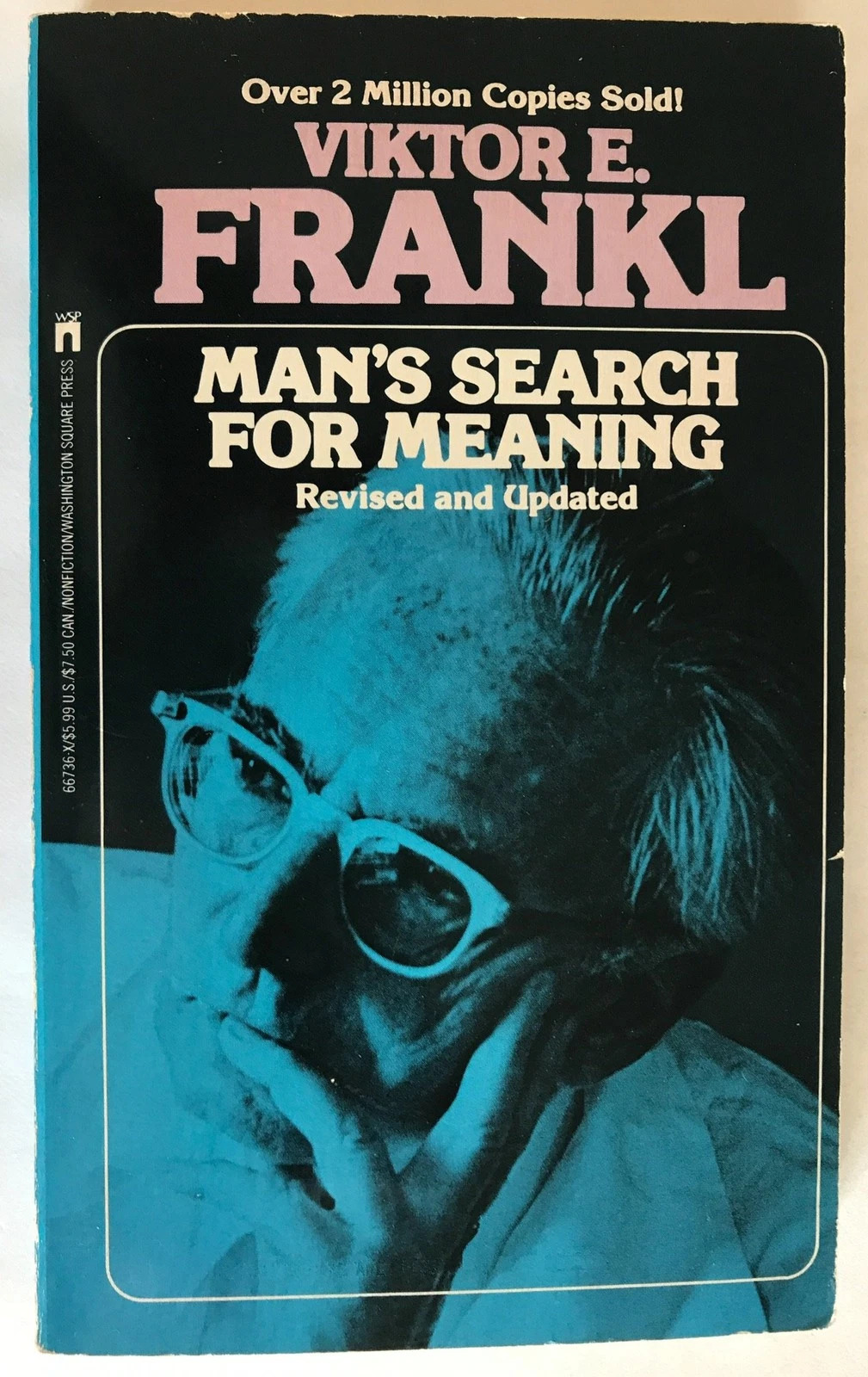
Viktor E. Frankl: Everything can be taken from a man but one thing: the last of the human freedoms—to choose one’s attitude in any given set of circumstances, to choose one’s own way
A friend recommended this for me, and I didn’t know what to expect. It’s a true story about a Jewish doctor who was in concentration camps during WW2. This guy was something special. He flat-out refused to be labeled as a victim after it was over and up to his death. His Jewish peers didn’t always like this, but Frankl moved on with his life and used his experience in the concentration camps to help people and to write this book.
He purposely left out the more gruesome details of his experience. He said in the book that you can easily look that up if you want to hear those details. Don’t get me wrong, it was still some of the worst experiences that you can imagine. The book has me thinking about how to handle situations better. You can really learn a lot from this.
Frankl was a psychiatrist in Vienna before World War II, already developing ideas about meaning and purpose as central to human psychology. That work was interrupted when he and his family were deported to Nazi concentration camps, including the Auschwitz concentration camp and later the Dachau concentration camp. His parents, brother, and pregnant wife did not survive. Frankl spent years moving through camps, observing not just suffering, but how different people responded to it.
While imprisoned, Frankl began shaping what would later become his theory of logotherapy (a meaning-centered psychotherapy focused on helping individuals overcome distress by finding purpose in life, even amidst suffering), the idea that the primary human drive is not pleasure or power, but the search for meaning. He paid close attention to prisoners who maintained a sense of purpose, even in small ways, and noted how that often affected their ability to endure.
After being freed in 1945, Frankl returned to Vienna. Within about nine days, he dictated the manuscript that would become Man’s Search for Meaning. The original German title was …trotzdem Ja zum Leben sagen (“…Nevertheless Say Yes to Life”). It was first published in 1946, initially with modest expectations, as one of many postwar accounts of camp life.
