

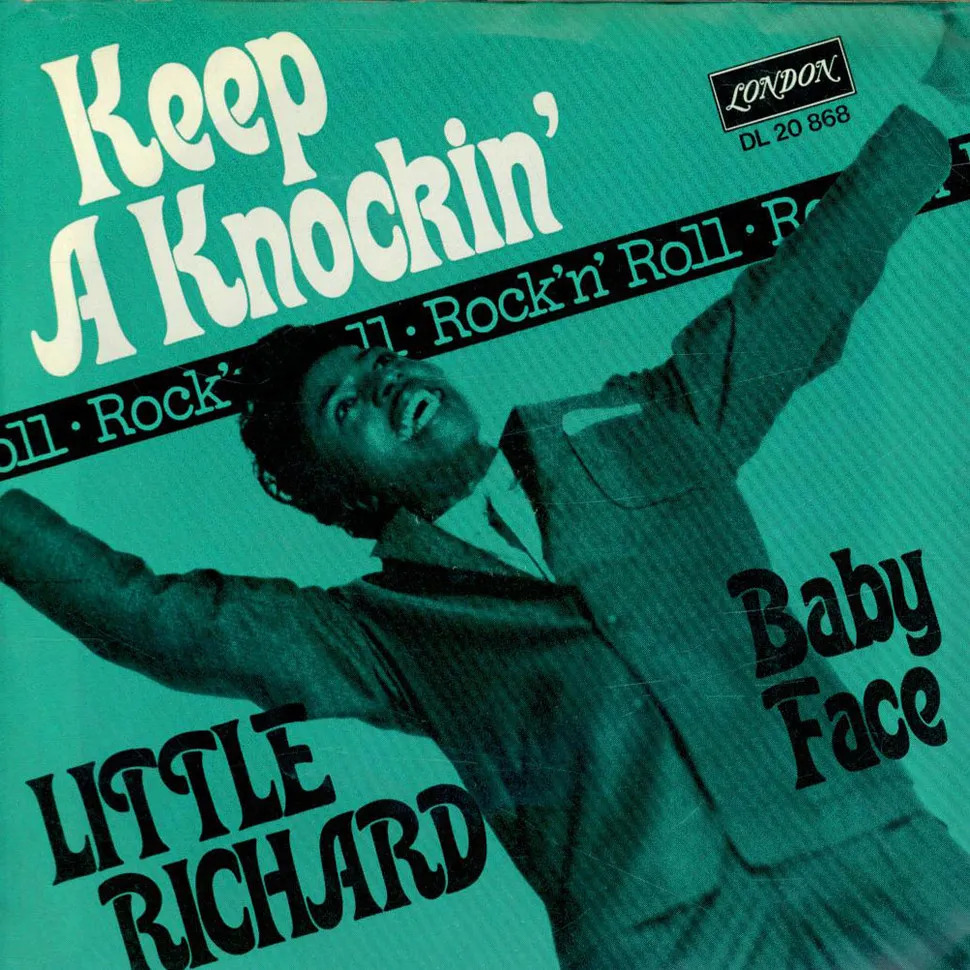
Every time I post Little Richard, I think of my dad. I never heard my dad gush over a music performer besides three artists. Elvis Presley, George Jones, and Little Richard. I think Richard was his favorite voice. He would tell me, no one, absolutely no one, sounded like Little Richard. My dad was born in 1938, so he was the perfect age (17) in 1955 to enjoy the rock and roll boom that was going on.
I only knew Richard from his manic songs, but Graham talked about him singing some ballads, so I checked them out. The man could sing a great ballad as well, but I’m not posting a ballad today. I had Little Richard’s greatest hits as a youngster, after all of the buildup from my dad. Since I got into the Beatles so early, I knew enough to know Paul was emulating Little Richard with Long Tall Sally. He did a great job, but nothing beats the man himself.
From the opening crash of Charles Connor’s drums, a bolt of energy that feels like it might knock your turntable off its spindle. Richard isn’t asking anyone in; he’s telling the world to keep knocking because the party inside is already out of control. It’s controlled chaos, and I love it. I also love Samuel Parker’s breakout sax solo in the middle.
The heartbeat of this song came from drummer Charles Connor, whose opening drum break is one of the most famous in rock history. Connor later said he borrowed the feel from a New Orleans parade rhythm and stripped it down. Connor has spoken about how Little Richard wanted the drums to sound like chaos barely held together, loud and urgent. That intro became so iconic that it later inspired John Bonham’s opening on Led Zeppelin’s Rock and Roll, but the original blueprint belongs to Charles Connor.
Listening to this song is like taking speed for 2 minutes. The lyrics are almost childishly simple, but the delivery makes them monumental. If you want to explain why Little Richard matters, just listen to this song and stand back. This is the sound of the door being slammed on the old world and kicked open into something louder and faster. No polish or no restraint.
The song was released in 1957, and it was credited to Little Richard but he wrote it based on a blues song by James “Boodle It” Wiggins in 1928 called Keep a-Knocking An You Can’t Come In. The song peaked at #8 on the Billboard 100, #2 on the Billboard R&B Charts, and #21 in the UK in 1957.
Keep A-Knocking
Keep a knockin’, but you can’t come inKeep a knockin’, but you can’t come inKeep a knockin’, but you can’t come inCome back tomorrow night and try it again
You said you love me and you can’t come inYou said you love me and you can’t come in (woo!)You said you love me and you can’t come inCome back tomorrow night and try it again (woo!)
Keep a knockin’, but you can’t come inKeep a knockin’, but you can’t come inKeep a knockin’, but you can’t come inCome back tomorrow night and try it again
You said you love me and you can’t come inYou said you love me and you can’t come in (woo!)You said you love me and you can’t come inCome back tomorrow night and try it again (woo!)
Keep a knockin’, but you can’t come inKeep a knockin’, but you can’t come in (woo!)Keep a knockin’, but you can’t come inCome back tomorrow night and try it again
You said you love me and you can’t come inYou said you love me and you can’t come inYou said you love me and you can’t come inCome back tomorrow night and try it again (woo!)
…

 PowerPop... An Eclectic Collection of Pop Culture
Well you’re Dad wasn’t wrong. The man was energy personified. Great song, interesting stuff on the drum/drummer. So glad you mentioned Wiggins.
LikeLiked by 2 people
I never heard that Wiggins song before…Richard just fed it steroids.
LikeLiked by 1 person
I have heard it, and I mentioned in a post on Richard back in 2020. And yes he fed it steroids. The original is what you might expect from a Blues song in 1928. Some of the covers before Richard are quite interesting. Bob Wills took a crack at as well.
LikeLiked by 1 person
I am surprised he got by with putting his name on it…unless it was public domain. I need to hear Bob Wills version…
LikeLiked by 1 person
The UK Christmas 1970 #1 – apparently a cover of a song by Smiley Lewis. Sounds a bit familiar!
LikeLike
Love that version Clive…this was caught in my spam! Sorry for the late reply.
LikeLiked by 1 person
No worries. They are related, aren’t they!
LikeLiked by 1 person
Yes they are!
LikeLiked by 1 person
One of my favorite singers, too. Definitely a distinct sound!
LikeLiked by 1 person
VERY…there is no mistaking him.
LikeLiked by 1 person
The image of the Specialty Records label spinning at 78rpm fueled my childhood. “Long Tall Sally” suddenly came to me one day this summer on a walk with my 6 month old granddaughter. I played it as soon as we got in the house and she immediately started dancing in her carseat and singing along. Little Richard has power! And you’re right – the party is already out of control!
LikeLiked by 3 people
That is the joy and immediacy of great music.
LikeLiked by 2 people
That is a great story about your granddaughter…his music is still relevant….I agree…he does have power. A controlled chaos…
LikeLiked by 2 people
I think the couples dancing in that video are on speed too. Whew. My mother had a different reaction than your father did. Even though she liked a lot of rock and pop music, Richard was one step too far for her. Every time he would be on TV screaming “Lucille!”, I would be fascinated, but she was not, to put it lightly. I can’t even imagine what my father would have thought of him. He would sometimes have a Saturday off, and my sister and I would be watching Soul Train, and he would always say “All they ever say is baby, baby, baby”. In their defense, I had older parents than most of my friends. My mother was 42 and my father 44 when I was born. Well there was and will only be one Little Richard. Sorry for going on again. Good post.
LikeLiked by 1 person
I could see why older people would not exactly approve of Little Richard or Jerry Lee Lewis…by just looking at them perform they probably saw them as a threat. Of course the teens ate it up.
You know…your dad WAS right about baby, baby, baby lol…but it was the way they did it that made it work! Talk as long as you want!
LikeLike
Every time I play the live version of “Cyprus Avenue” on Van’s It’s Too Late to stop now and he says “Baby” about 25 times in a row I think of my father.
LikeLiked by 1 person
That is perfect! It’s all about the way you say it….and I’m glad you remember your dad that way.
LikeLike
A real rocker and Little Richard was a true performer.
LikeLiked by 2 people
I couldn’t have said it better…what you saw is what you got…over the top greatness.
LikeLiked by 1 person
Simple, loud, all but unhinged- what kid from the dull grey post-war days when ‘life was a serious business’ wouldn’t want to dance their blues away to something as gleefully free and joyful as this?
LikeLiked by 2 people
Just pure energy…and yes I would throw unhinged in there as his sound. “Subtle” wasn’t in Little Richard’s vocabulary.
LikeLiked by 1 person
he was a showman that’s for sure, and his place in history would be assured even if just by how much he inspired the Beatles. I didn’t know your Dad loved his stuff.
LikeLiked by 1 person
Oh yes…those three performers were it. Dad talked about him before I heard him…and when I did…it lived up to Dad’s hype.
LikeLiked by 1 person
I wasn’t that familiar with this one. It’s brilliant, the way it’s mixed makes it sound like a runaway train barelling straight at you. The lyrics are stupidly simple, but that’s the point. Imagine how this sounded to a kid in the fifties. Wooooo!
LikeLiked by 1 person
When I first heard it I thought…chaos and I love it. Plus those drums were familiar….of course with Rock and Roll by Zeppelin. I can’t imagine hearing this in the 50s…it made Chuck Berry and the rest sound tame.
LikeLiked by 1 person
That’s a good shout with the drums. Shows how influential these rock n roll stars were with the acts who have essentially stolen their thunder
LikeLiked by 1 person
The sax does it for me. My old man was a jazz guy but he did lean towards Jerry Lee and Cash.
LikeLiked by 1 person
That sax does explode in this one. Well we were pointed in great directions.
LikeLiked by 1 person
Little Richard is the consummate entertainer. He gives his all and always has. Such a good singer and pianist, and he has a great sense of style.
LikeLiked by 1 person
Cool backstory Max…still remember Little Richard being in the Cinderella video for Shelter Me….
LikeLiked by 1 person
Little Richard would be a hard rock singer in later times.
LikeLike
I used to laugh when one of our DJ’s used to call him Little Dick on the air. LOL Love so many of his tunes
LikeLiked by 1 person
LOL…never thought of that but it works!
LikeLiked by 1 person