

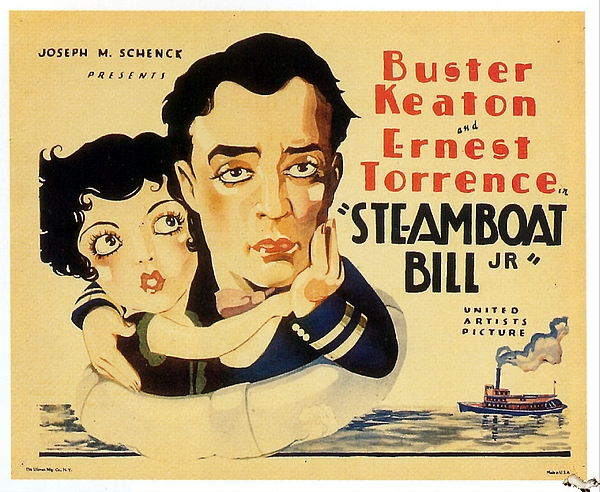
It’s hard to tell you how big of a fan of Buster Keaton I am. Not only do I love his on-screen character, but his filmmaking techniques are still second to none. I got to know Buster through reading about Clara Bow. First, about his Sunset Boulevard cameo, and then I went back and watched his films. The Navigator, The General, Sherlock Jr., Battling Butler, and, of course, Steamboat Bill Jr. I also watched his “shorts” that he made before features. There was no one like him. No one took a fall like he did. He was a natural acrobat. He didn’t use stunt men because the stunt men would say they could not do it like Buster Keaton. This movie has the most famous scene of Buster Keaton’s film career and possibly of silent movies in general.
He was a little off kilter compared to his comedy peers. He was more subtle than Chaplin or Harold Lloyd. Keaton used non-movement to his advantage. You would see him in a crowd easily. They would be moving along, and his stillness would get your attention. Buster was also an excellent filmmaker with the way he paced a movie. He didn’t fake stunts…he didn’t like cutting in at the last minute. He wanted the scene to be filmed in one shot and completely natural. Ok, enough of my love for Buster Keaton.. .well, nah, I’ll continue.
Buster Keaton’s Steamboat Bill, Jr. was released in 1928. It came near the end of the silent film era. Keaton plays William Canfield Jr., a young man who returns home to spend time with his Riverboat Captain dad after years away at college. His father, Steamboat Bill Canfield, is a tough old riverboat captain who is disappointed to find his son is more interested in music and fashion than life on the river. A generation gap that has been going on since time began. The film centers on their rocky relationship and a rivalry between competing steamboat owners. The scenes between Buster and Ernest Torrence, who plays his father, are very funny.
The movie was filmed during one of the most difficult periods of Keaton’s career. He was still making films independently before losing much of his creative freedom after signing with MGM. Even so, he poured everything he had into this production. The river scenes were expensive and complicated to film. Entire sets were built and later destroyed for the movie’s famous storm sequence.
Today, Steamboat Bill, Jr. is remembered for one of the greatest stunts in film history. During a tornado scene, the front wall of a house falls directly toward Keaton. He survives because he stands in the exact spot where an open window passes around him. There were no special effects. No trick photography. If he had missed his mark by even a few inches, he could have been seriously injured or killed. The front of that building weighed 2 tons, so it would not twist in the wind. The scene remains one of the most famous moments in silent film. The director turned his head away during that scene because he feared Buster would misjudge it.
Although the movie was not a major box office success when it was released, its reputation grew over the years. Many film historians now consider it one of Keaton’s masterpieces. Nearly a century later, this movie still feels relatable and shows why Buster Keaton is still remembered.
The making of Steamboat Bill, Jr. was almost as dramatic as the film itself. During production in 1927, the devastating Mississippi River floods were still fresh in the public’s mind. Keaton’s original ending involved a flood, but he decided to change it to a cyclone and storm sequence to avoid reminding audiences of a recent tragedy.
The final storm scenes were some of the most expensive ever filmed for a silent movie. Huge sets were built and then destroyed by giant wind machines, water pumps, and carefully planned special effects. Keaton insisted on doing most of the dangerous stunts himself, including the famous falling house facade scene. The film would also become his last truly independent production before he joined MGM. It was his final chapter of the creative freedom that made Buster Keaton one of the greats of film.
Complete Movie
